


Removable vibrating bottom and hygienic fabric silos: An industrial crepe shop streamlines its flour silo cleaning process
In an industrial crêperie operating non-stop all year round, two fabric flour silos required frequent cleaning to prevent insect infestations, taking 2 to 3 days of downtime per silo. SYVRAC redesigned these flexible silos around a removable hygienic vibrating bottom and the Easyvrac® system.
Here are the questions the client was asking before the project:
- How can I prevent my flour from being contaminated by insects and mealworms?
- How can I clean my flour silos without relying on an external contractor for several days?
- How can I service my silos without shutting down a continuously operating plant?
- How can I reduce physical strain and safety risks for my maintenance technicians?

Objective: Making the client self-sufficient in cleaning its flour silos
The objective: enabling the client’s maintenance staff to disassemble, clean, and reassemble their fabric silos completely independently, safely, and with less physical strain, without ever halting production.
At the same time, it was necessary to eliminate areas where flour stagnates and insects breed, in order to meet the quality department’s strict requirements.
Context: An industrial crêperie running continuous production
The client is an industrial crêperie and long-standing SYVRAC partner operating across two sites: one dedicated to fresh crêpes and galettes, and the other to frozen products.
At the fresh-product site, raw material storage relies on two flexible fabric silos of 18 metric tons each (10-ton turnovers)—one for wheat flour and the other for buckwheat flour—supplemented by an older wooden silo.
Two constraints made the situation challenging:
- A plant that never stops: operations run continuously year-round, with no scheduled maintenance shutdowns.
- Recurring contamination: mealworms and insects required very frequent silo cleanings. In the original setup, every fabric disassembly and reassembly required an external service call lasting 2 to 3 days per silo.
The result: a heavy operational burden, scheduling constraints, and reliance on an external contractor for every cleaning.
Solution: A fabric silo redesigned for hygiene and maintenance
Rather than simply replacing 10-year-old fabric bags, SYVRAC redesigned its flexible silos around five innovations, each addressing a specific client constraint.
1. Hygienic vibrating bin discharger removable by a single operator
This is the centerpiece of the project: a two-part vibrating bin discharger, custom-designed specifically for this installation.
- At the top, a circular stainless-steel ring clamped onto the fabric, maintaining its shape without damaging the material.
- At the bottom, a unit integrating the vibrating discharger and deflector, attached via a simple manual “plug-and-play” connection that protects the fabric.
A single operator can now remove the bottom unit, clean the air pocket beneath the deflector, and reassemble everything in about 1 hour. The old clamping rings, which were harder to handle, are gone and the fabric remains fully protected.

2. Easyvrac® system: Replacing a fabric silo in less than a day
The old fabric silos were replaced with the Easyvrac® system, enabling safe removal and reinstallation by the client’s own teams, completely independently. Turnaround time dropped from 2–3 days to less than one day per fabric silo, without shutting down the plant.
3. Fixed top dome on the silo: A “plug-and-play” interface
A rigid Ø 600 mm metal dome, supported directly by the frame, houses:
- the pneumatic filling piping (Ø 104 mm);
- the high-level sensors;
- a sealed inspection hatch.
When removing the fabric bag, the dome and piping remain fixed in place on the structure. No more tearing of fabric inlet sleeves caused by overpressure during bulk truck unloading!
4. Chamfered-angle cone: Zero retention zones
The fabric geometry was modified with 45° chamfered corners at the cone taper. These truncated angles eliminate dead zones where flour stagnates and insects thrive.
5. Protective internal sleeve (“gobette”)
A double layer of fabric in the lower section separates the mechanical sealing zone—subjected to vibration—from direct contact with the flour. The result: no more shearing at the clamping collar, and zero risk of leaks!

Technical specifications of the flour fabric silos
| Specification | Value |
|---|---|
| Silos covered | 2 flexible fabric silos (wheat flour, buckwheat flour) |
| Capacity | 18 metric tons per silo (10-ton turnovers) |
| Filling | Pneumatic, Ø 104 mm piping |
| Top interface | Rigid Ø 600 mm metal dome on frame, high-level sensors, sealed inspection hatch |
| Fabric bag | Easyvrac® system, 45° chamfered-angle cone, double-layer internal sleeve |
| Discharge | Two-part hygienic vibrating bin discharger (stainless-steel flange + vibrating discharger & deflector unit), manual bolted connection |
| Discharger removal | 1 operator, approx. 1 hour |
| Fabric bag replacement | Less than one day per fabric bag, by the client’s teams |
Results achieved for flour silo cleaning
| Indicator | Before | After |
|---|---|---|
| Fabric bag replacement | 2 to 3 days per silo, with SYVRAC | Less than one day, by the client’s team |
| Bottom cleaning | Clamping rings difficult to handle | 1 operator, approx. 1 hour |
| Production | Maintenance had to be squeezed into a non-stop plant schedule | Maintenance carried out without halting overall plant operations |
| Hygiene | Retention zones, insect contaminations | Chamfered-angle cone, easy-to-clean bottom unit |
| Reliability | Torn inlet sleeves, risk of leaks | Fixed top dome, anti-shear protective sleeve |
Benefits of the SYVRAC solution
✔ Sanitary control: reduced retention of raw materials such as flour, with simpler and more frequent cleanings when needed to meet quality department requirements.
✔ Autonomy: the client’s maintenance teams carry out operations on their own, whenever they choose, without waiting for an external contractor.
✔ Production continuity: no maintenance operation requires shutting down the plant.
✔ Safety and ergonomics: a single operator, a simple “plug-and-play” connection, and reduced manual handling and physical strain.
This project demonstrates that a well-designed flexible silo can meet the strictest hygiene standards. Also discover our HORNET’PROTECT solution against insect intrusion and our case study on fabric silo replacement without dismantling the structure.
Testimonial
Our SYVRAC expert, Stéphane B., explains the approach: “The client wasn’t just looking for new fabric bags, but for an installation that its own teams could disassemble and clean easily and safely. That’s why we chose to make all sensitive components fixed (dome, piping, sensors) and to design a vibrating bin discharger that a single operator can remove in one hour.”
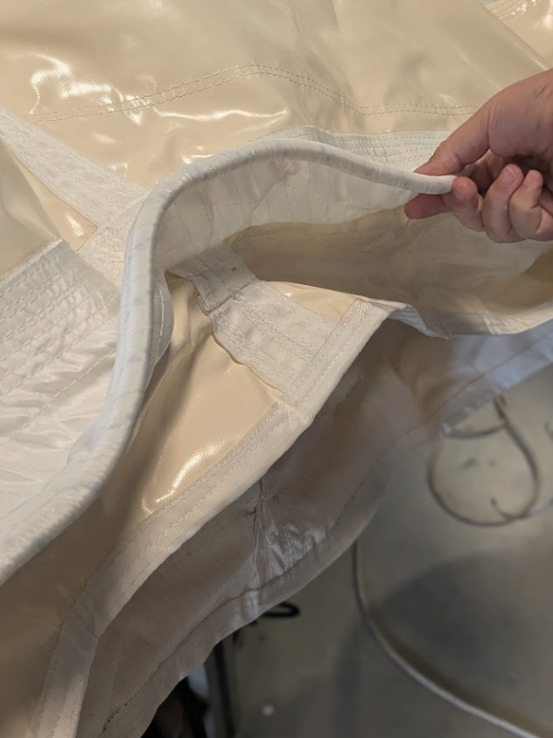
Internal chute on fabric silo
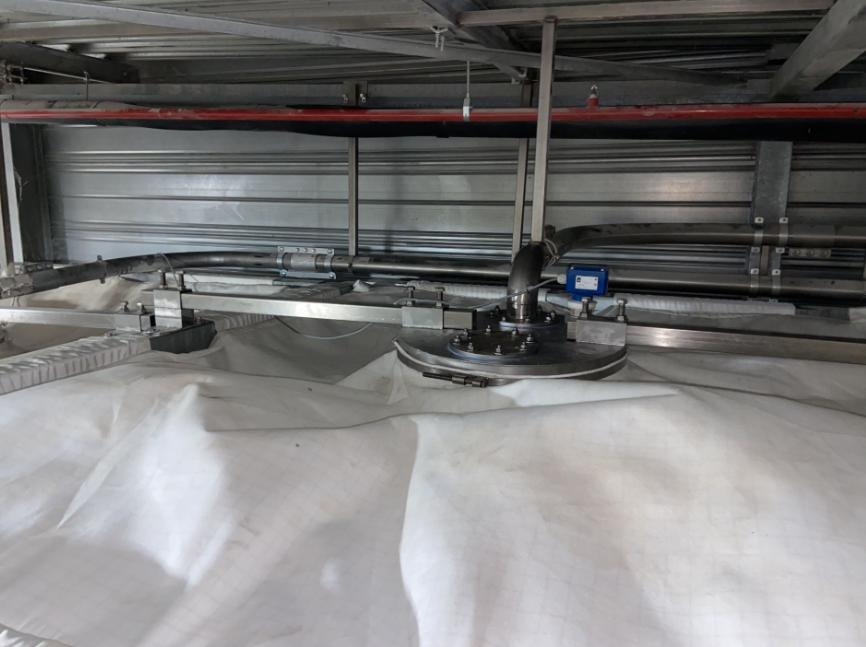
Easy equipment hookup on silos
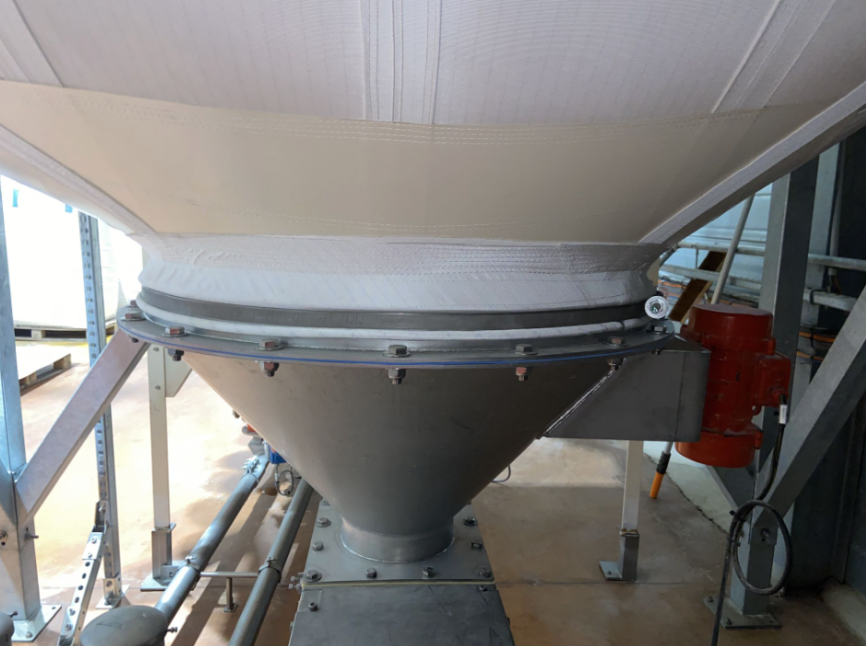
“Plug-and-play” vibrating bottom
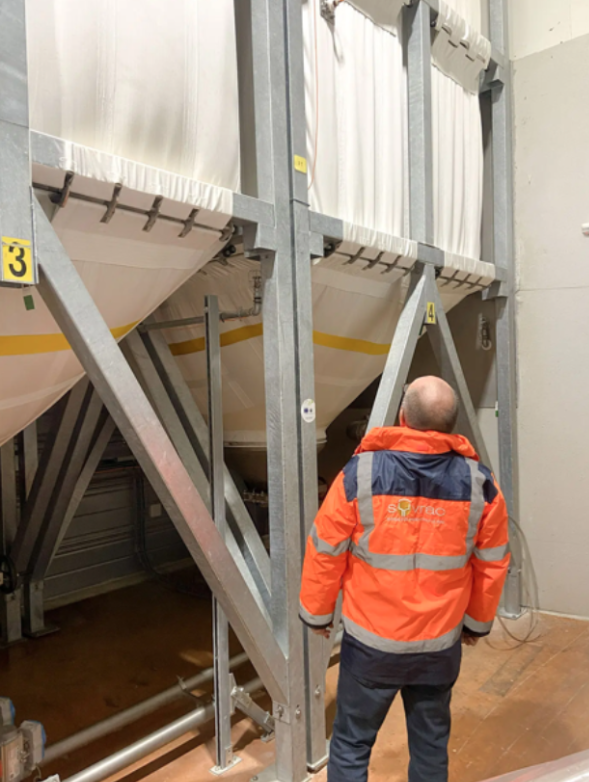
45° beveled cone panels
FAQ: Cleaning and vibrating bin dischargers for flour fabric silos
How can insects and mealworms be prevented in a silo?
By eliminating retention zones where flour stagnates (chamfered-angle cone, vibrating bin discharger), regularly cleaning surfaces in contact with the product, and protecting silo openings. An easily removable bottom unit allows cleaning as frequently as the quality department requires.
How often should a flour silo be cleaned?
It depends on the product, turnover rates, and the site’s quality requirements. In the event of insect contamination, cleanings become very frequent—which is why having an installation that in-house teams can disassemble quickly on their own, without an external contractor, is so valuable.
Can a flexible silo’s vibrating bin discharger be removed without an external contractor?
Yes, with a discharger designed for the job! In this project, the two-part vibrating bin discharger is removed via a simple “plug-and-play” connection: a single operator removes it, cleans the air pocket beneath the deflector, and reinstalls it in about 1 hour.
How long does it take to replace the fabric bag of a flexible silo?
With the Easyvrac® system, less than one day per fabric bag is enough when performed by the client’s teams, compared to 2 to 3 days with an external contractor in the previous configuration.
Can maintenance be performed on a flour silo without stopping production?
Yes. A fixed dome, piping kept in place, and a removable bottom unit make it possible to service one silo at a time without halting overall plant operations.

Let's build together your storage solution
Stéphane B.
Powder processing solution expert