

Storage of hide-tanning fleshing waste
Our client is a French company, founded in 1968, specializing in livestock slaughtering and meat processing. This food group comprises 60 industrial sites, including 29 slaughterhouses, as well as a subsidiary dedicated to hide tanning.
These hides primarily originate from their own slaughterhouses but also come from other abattoirs located in France. The tanning process transforms animal skin into leather through several stages aimed at eliminating meat residues, lipids, and hair. These steps require the use of various chemicals such as sodium hydroxide for deliming, sodium hypochlorite for bleaching, potassium dichromate for mineral tanning, lime for unhairing, chlorides for cleaning, sulfuric acid (H2SO4) for pickling, formic acid (HCOOH) for pickling, surfactants to improve the penetration of tanning agents, sodium sulfide (Na2S) for degreasing, and sodium and ammonium salts for neutralization.
Once treated, the hide is transformed into leather using trivalent chrome (Cr3+), vegetable tannins, mineral salts, and colorants, thereby ensuring a high-quality final product.
The customer’s problem
The residue left over from scraping hides, known as carnasse, poses several significant challenges in the animal hide tanning process.
- Variation depending on temperature
When outside temperatures drop, carnass tends to solidify, which makes it considerably more difficult to transport and store. This solidification makes handling carnass extremely difficult, requiring additional effort and specialised equipment to move and store it efficiently. - Current storage methods
Until now, our client has stored this residue in metal bins placed outside buildings, exposed to the elements. These bins were loaded manually or via a transfer network equipped with a pump, which can be laborious and inefficient. Manual loading is not only physically demanding for employees, but also prone to human error and inefficiencies. In addition, exposure to the elements can degrade the quality of the waste and further complicate its storage. - Pipe blockages
Temperature fluctuations sometimes cause the product to become blocked in the pipes. Attempts to clear the blockage by applying pressure have resulted in pipes bursting, causing costly technical problems and production stoppages. These blockages can not only damage equipment, but also lead to unplanned production stoppages, affecting overall plant productivity. The repairs required to replace or repair damaged pipes can be costly and time-consuming. - Release of hazardous gases
Sewage sludge, which is highly methanogenic, releases H₂S (hydrogen sulphide) gas, which irritates the mucous membranes and respiratory tract. At high concentrations, this gas can cause bronchospasm, pulmonary oedema and even respiratory depression (at concentrations above 700 ppm), posing serious risks to workers’ health and safety. Hydrogen sulphide is a toxic gas that can cause severe irritation and serious respiratory problems, requiring strict safety measures to protect employees. Companies must implement adequate ventilation systems and personal protective equipment (PPE) to minimise the risks associated with exposure to this gas.
The handling solution provided by Syvrac
In order to improve working conditions for its employees and resolve issues related to offal storage, our client sought our expertise to design a tailored solution. We therefore proposed the installation of special composite silos, designed for optimal storage of offal under controlled conditions. To prevent blockages in the piping, the client had insulated piping fitted with an electric heating element, thus ensuring a continuous, uninterrupted flow.
Details of the proposed solution
Composite silos on gantry and storage optimisation
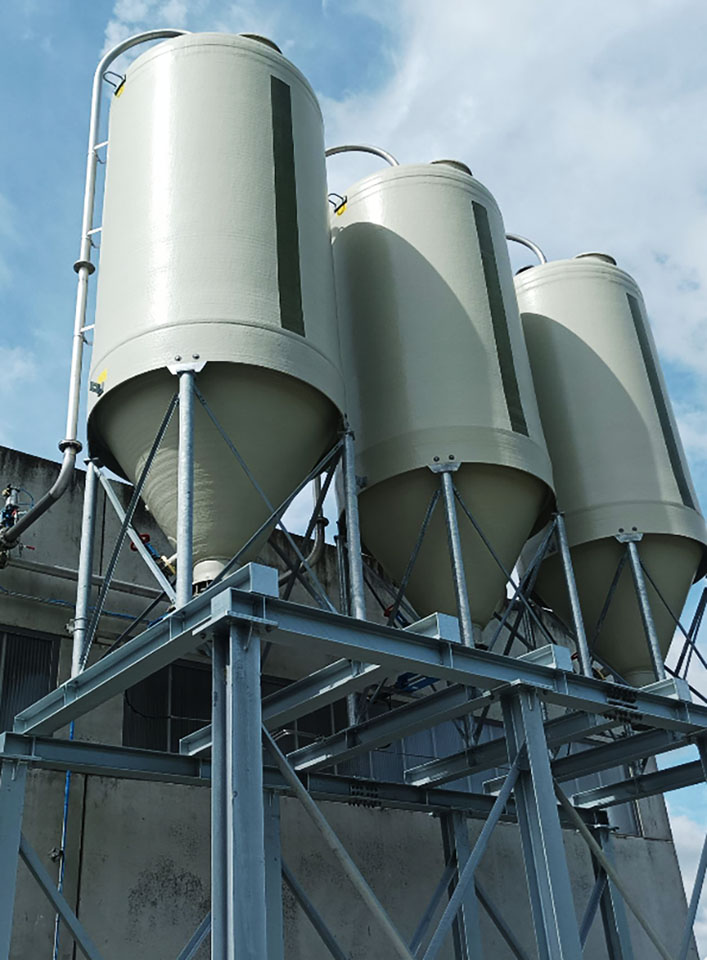
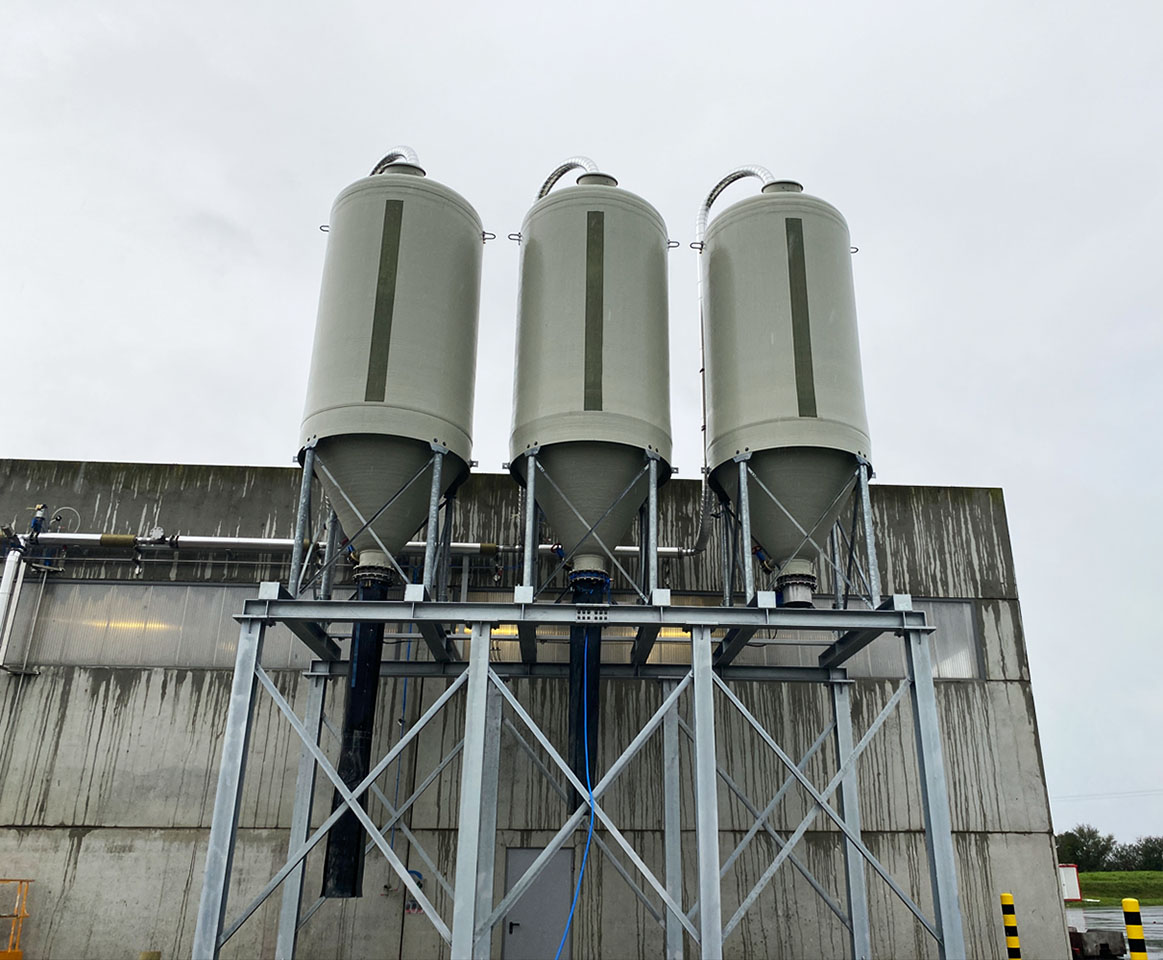
We offer high-performance polyester composite silos, specially designed for the storage of products such as offal. These silos are installed on a robust IPN structure (wide-flange I-beams), which allows for quick and efficient unloading thanks to an optimised passage for lorries. This configuration greatly facilitates logistics operations and reduces handling times.
Key features
Our silos are made from composite materials reinforced with polyester, which ensures remarkable lightness, corrosion resistance and durability. The insulated cones enable optimal preservation of stored materials, thus maintaining their quality and properties. Optional heating elements can be integrated into the cone and composite cylinder to maintain a constant temperature, preventing products from freezing, even in the event of climatic variations.
The installation was carried out on a gantry, adapted to the specific dimensions and requirements of our customer. The entire system complies with European standards to guarantee safety and reliability for operators over time. This compliance ensures not only worker safety, but also the long-term durability and efficiency of the equipment.

The advantages of the Syvrac solution
Composite silos are an innovative and high-performance storage solution designed to meet the specific needs of various industries. Developed for the food industry, livestock farming and waste management, our silos offer numerous advantages that set them apart from traditional solutions. Their thermal insulation, IPN structure, corrosion resistance and ease of unloading transform logistics operations and improve efficiency within the company.
- Thermal insulation (optional):
With the addition of 50 mm thick polyurethane (PUR) foam segments positioned on the roof, cylinder and cone, the insulation on our silos preserves the quality of the stored materials in all circumstances. - IPN structure:
Custom-designed, it offers optimal stability, even in the most demanding environments. Unlike other products on the market, our approach is entirely bespoke and responsive, in order to meet the specific expectations of each customer. - Corrosion resistance:
The composite materials used in the manufacture of the silos ensure exceptional corrosion resistance, extending their service life and reducing maintenance costs. - Ease of unloading:
The IPN structure allows for quick and efficient unloading, optimising logistics operations and reducing downtime.
Installation of three silos for storing animal carcasses
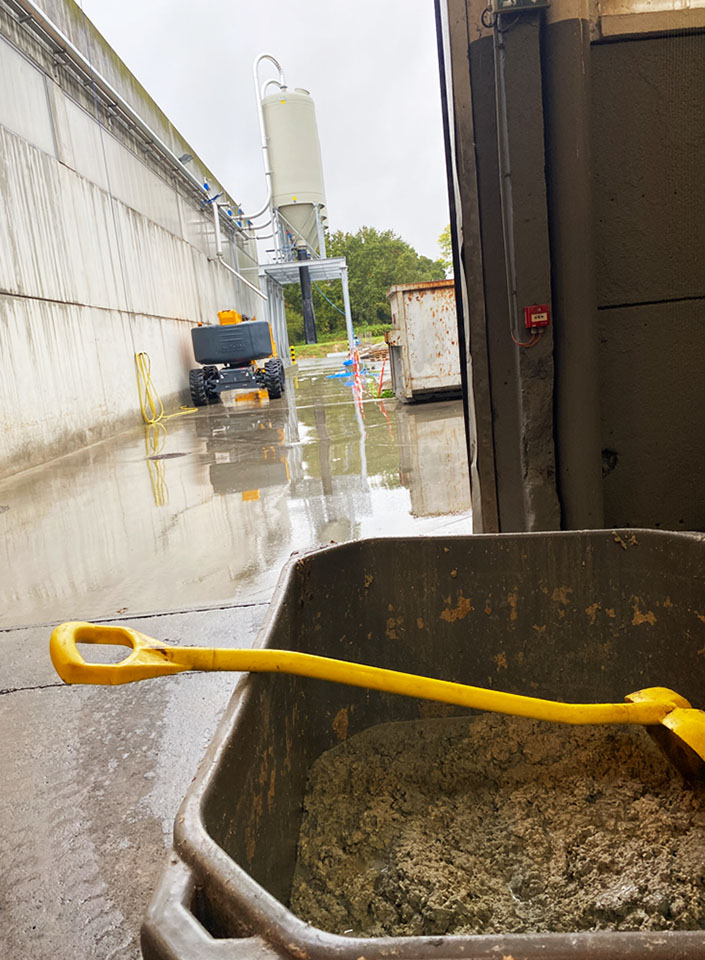
Silos for storing animal carcasses
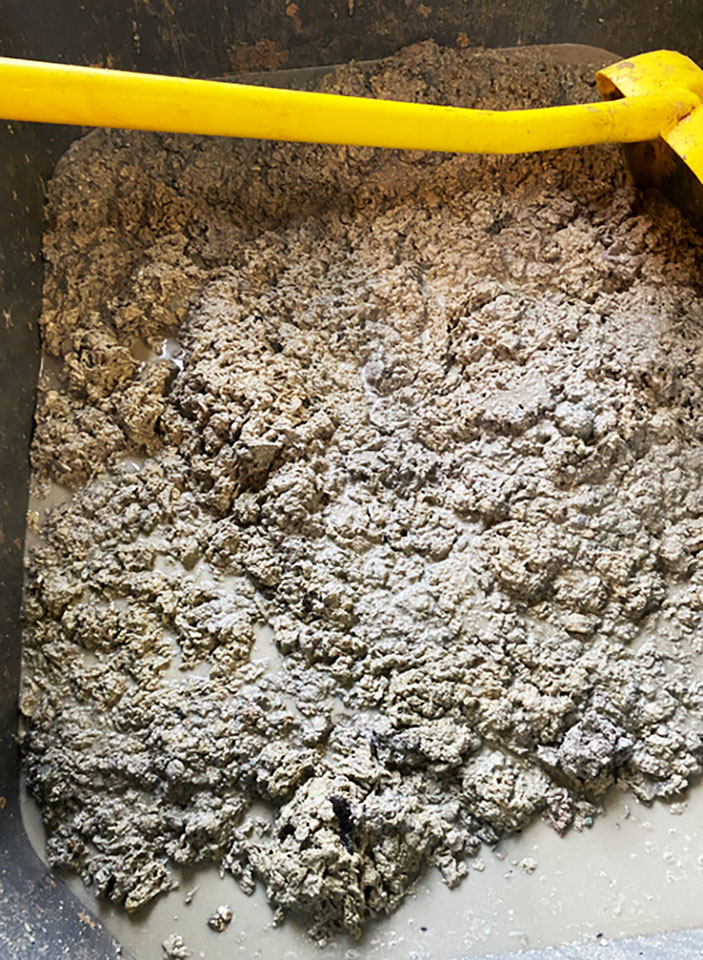
Hide waste from skin tanning